
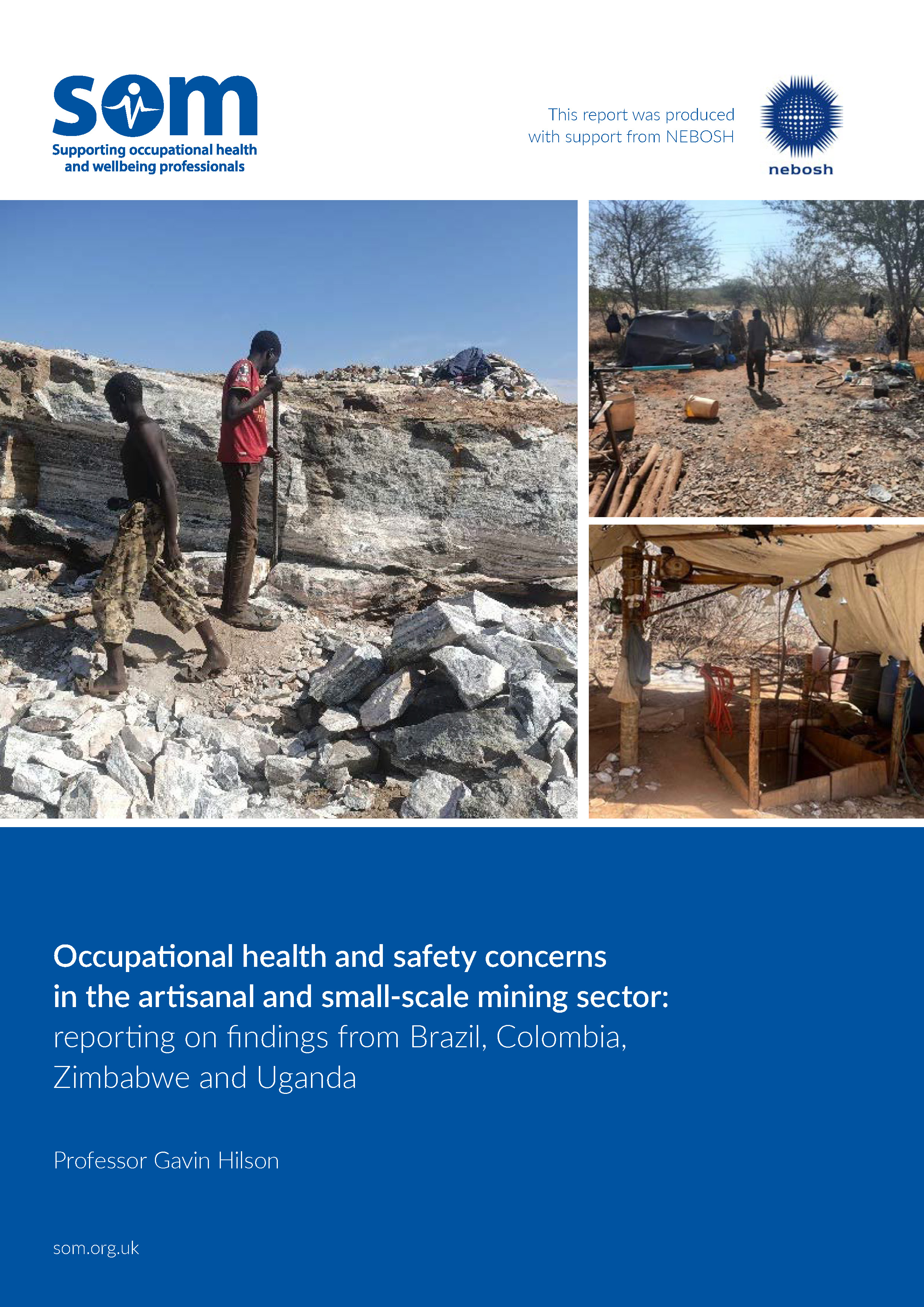
A new research report published by the Society of Occupational Medicine (SOM) and International Occupational Medicine Society Collaborative (IOMSC) highlights the occupational health and safety risks of artisanal and small-scale mining (ASM) in Brazil, Colombia, Uganda and Zimbabwe.
The report, which follows a one-year research project funded by the National Examination Board in Occupational Safety and Health (NEBOSH), identifies some of the worst occupational health and safety risks facing ASM workers and examines why informality in the sector still persists.
The report finds that in all four study sites:
- Informality underlines occupational health and safety (OHS) risk, and risk-taking is often driven by poverty
- Unsafe physical working conditions, such as pit and tunnel collapse, unstable slopes and inadequate ventilation persist
- Miners have little access to personal protective equipment (PPE) and safety training
- Miners and their families have limited or poor access to healthcare
- Chemical hazards including mercury exposure, dust exposure, and silica related diseases are widespread
- Physical injuries, including musculoskeletal (MSK) disorders, exhaustion and heat stress are common
The report also reveals that despite understanding the dangers, miners continue to work informally because their precarious economic circumstances leave them with few viable alternatives. As one miner in Kasanda, Uganda put it: “We enter the pit knowing it can collapse. But if we don’t work, our children don’t eat.”
The report’s author, Professor Gavin Hilson commented: “High permit fees, bureaucratic licencing processes and limited access to mineral-rich land leave many ASM miners with little choice but to operate informally. They deserve greater attention, but the sector’s persistent informality and lack of regulation continue to stand in the way of improving their health and safety. Until their situations change, these miners are unlikely to change their practices.”
Moving forward
In response, SOM has launched a second phase of the project. Funded by NEBOSH Social Purpose Programme across three years, the project will focus on delivering targeted occupational health and safety interventions through established ASM cooperatives and associations in the four partner countries. Working with OK International, SOM will design a series of locally produced information, education and communication materials to improve miner’s knowledge, behaviours and practices related to occupational health and safety. These materials will be delivered through a sustainable peer-to-peer training model and changes in how miners work will be evaluated over the course of the project. An advocacy campaign and policy engagement with national and international stakeholders, focussing on strengthening occupational health protection for ASM workers will also be developed.
Nick Pahl, SOM CEO, said: “By linking the evidence generated in the first phase with practical action on the ground, this new phase provides a unique opportunity to translate research findings into measurable improvements in the occupational health of ASM miners and their communities, whilst creating a foundation for longer-term change and stronger occupational health and safety within ASM.”
The research has also informed a project also funded by NEBOSH’s Social Purpose Programme for occupational health and safety training for ASM workers in India. This project was launched in 2026 through a collaboration between SOM and St John’s Medical College, Karnataka, using insights generated through this report, alongside country-specific evidence and stakeholder input from India. In doing so, the training content reflects both the common occupational risks identified across ASM communities and the specific social, regulatory, and operational realities of the Indian ASM context. You can read more about this here.
SOM and IOMSC are grateful for the continued support from NEBOSH, our in-country leads Professor Dingani Moyo, Dr Maria Borda, Dr Deogratias Sekimpi, Carlos Henrique, and their wider teams, our academic lead Professor Gavin Hilson, and our expert steering group.